
How to use this page. Print it, assign an owner beside every phase, attach the written evidence, and keep unresolved items open. A checked box records a review; it does not certify a product, location, or legal outcome.
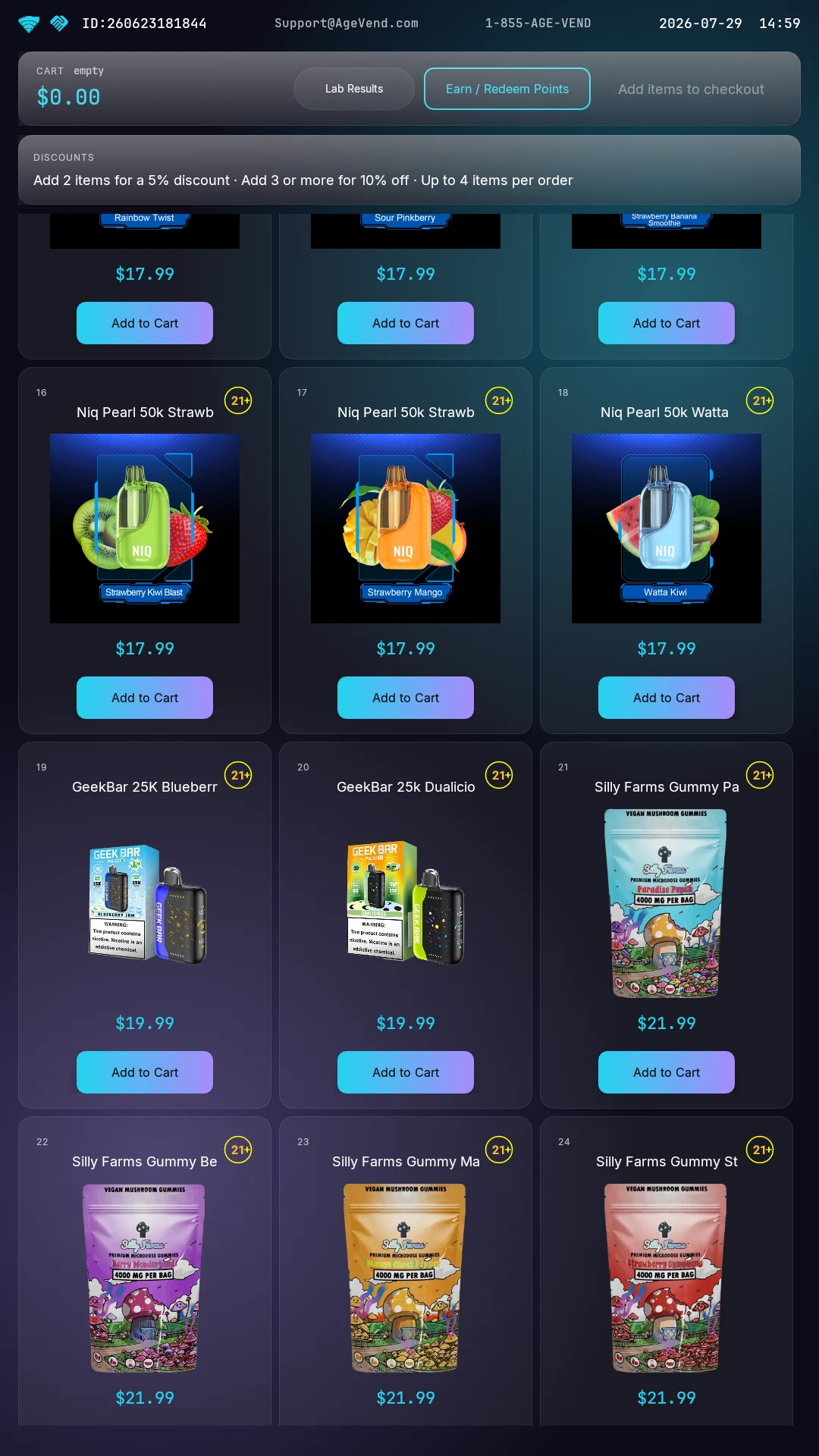
Published transaction economics: ID + face verification is $1.00 per attempted verification. Fingerprint verification is $0.50 per successful match, with no fee on failed fingerprint scans. Card processing is provided by Lifted Payments at 3.99%; a separate payments application and approval are required before go-live.
See the complete operation.
Inspect every demo page, then request delivery scope and financing options for your route.
Prove the machine can arrive and operate
The AV-1 is 72 inches high, 60 inches wide, and 36 inches deep. The delivered configuration can add handling, clearance, power, network, floor, and venue requirements that must be confirmed separately.
- Measure every door, hallway, turn, elevator, ramp, curb, and floor transition from unloading to placement.
- Confirm customer approach, accessibility route, queue direction, lighting, camera coverage, and emergency egress.
- Get the quoted configuration’s power, connectivity, service-clearance, environmental, and floor-loading requirements in writing.
- Record venue access hours, delivery rules, insurance requirements, incident contacts, and the approved final position.
Price the complete deployment
- Start with the published $9,500 AV-1 base machine price; separate the cabinet from freight, taxes, software, verification, payment processing, implementation, inventory, licensing, placement, and site work.
- Confirm whether each proposal item is one-time, recurring, usage-based, estimated, optional, or third-party.
- If financing is used, review the secure application, underwriting conditions, approved rate, term, payment, fees, collateral, funding conditions, and final documents.
- Assign who purchases starting inventory and who funds replenishment, refunds, chargebacks, repairs, connectivity, and venue economics.
Approve products and the location together
- List every intended category and SKU; document the authority used to decide whether it may be sold from that machine at that location.
- Confirm licenses, registrations, signage, supervision, hours, distance or zoning limits, customer disclosures, and record-retention requirements.
- Review package dimensions, slot fit, temperature/environment, expiration, lot or lab-report data, recalls, and replenishment ownership.
- Set a change-control rule so a new product is not loaded merely because it physically fits.
Test success, failure, fallback, and support
- Walk the initial ID + face flow on the real kiosk and record the operator policy for a failed or interrupted verification.
- Review optional fingerprint enrollment and return matching, including customer choice, fallback behavior, deletion/support questions, and the published $0.50 successful-match fee.
- Confirm the $1.00 per attempted ID + face verification fee and which fallback path produces a billable attempt.
- Document the customer support path and the evidence the operator can review without exposing customer data.
Complete underwriting before go-live
- Complete the separate Lifted Payments application and approval required for the published 3.99% processing path.
- Confirm accepted payment methods, settlement account, statement access, refunds, partial or failed dispense handling, chargebacks, and support contacts.
- Configure tax settings by product and location with the buyer’s tax professional; test receipts and reports before launch.
- Reconcile a safe test transaction across kiosk, payment result, dispense result, operator transaction record, and settlement reporting.
Run the route from the exception queue
- Inspect the synthetic public demo’s machine, inventory, transaction, customer, fault, tax, purchase-order, lab-report, campaign, and team pages.
- Assign owners and response targets for live fault reports, failed dispenses, low stock, stale lab data, connectivity, payment exceptions, and customer issues.
- Define planogram, counts, restock proof, variance review, purchasing, lot/expiry practice, and route schedule.
- Confirm remote management permissions, team roles, audit expectations, support handoffs, and the venue’s escalation contact.
Do not close an unanswered responsibility
- Attach the written quote, approved financing terms if any, payments approval, site plan, product decision file, venue agreement, and launch checklist.
- Name the buyer, venue, AgeVend, payment provider, delivery provider, and other party responsible for every remaining task.
- Schedule post-install verification, test transactions, initial stocking, staff handoff, customer support, and the first route review.
Questions buyers ask
What are the AV-1 dimensions?
The verified cabinet dimensions are 72 inches high, 60 inches wide, and 36 inches deep. Confirm delivery, clearance, power, network, and site requirements separately for the quoted configuration.
What is included in the $9,500 price?
$9,500 is the published AV-1 base machine price. The written quote should identify freight, taxes, software, verification, processing, implementation, inventory, licensing, placement, and other deployment inputs separately.
Does the machine make a placement legal?
No. Operators remain responsible for the rules and approvals that apply to the selected products, location, verification process, payment setup, and ongoing operation.
Turn the checklist into a written route scope.
Bring the open items to an AgeVend route specialist, inspect the live kiosk and synthetic operator demo, then confirm the complete deployment in writing.