
Updated July 29, 2026. This commercial planning guide is not legal, tax, payment, or financing advice. Requirements vary by product, location, program, and jurisdiction.
Published transaction economics: ID + face verification is $1.00 per attempted verification. Fingerprint verification is $0.50 per successful match, with no fee on failed fingerprint scans. Card processing is provided by Lifted Payments at 3.99%; a separate payments application and approval are required before go-live.
See the complete operation.
Inspect every demo page, then request delivery scope and financing options for your route.
Treat every machine as a selling location
A route may cross cities, counties, and states with different registration, rate, product, and reporting requirements. Record the legal operator and exact physical address for each machine. Do not assume that the warehouse, company office, or customer billing address is the transaction location.
AgeVend’s operator experience includes tax settings alongside products, machines, orders, and reporting. Configuration should be reviewed before the first transaction and whenever a machine, product, ownership structure, or applicable rule changes.
Map products to the right treatment
Different product categories can receive different tax treatment, and package or promotional changes can matter. Maintain a controlled product classification and avoid using a catch-all category simply because the machine contains many SKUs.
Have a qualified tax professional confirm the product and location logic. Document the source and effective date of each decision so an operator understands why a setting exists and when it should be rechecked.
Control who can change settings
A small rate change can affect every transaction at a location. Limit tax configuration to authorized roles, require a review process for material changes, and preserve an audit trail showing the prior value, new value, user, and effective time. Route technicians should not need broad tax permissions to restock or service a machine.
Test changes before a public launch and verify the customer-facing total, order record, refund behavior, and reporting output. Document how the system handles a machine that has not yet received an updated configuration.
Keep transaction evidence reconcilable
Tax reporting depends on complete transaction records. Preserve the selling location, product, taxable amount, tax amount, total, time, payment result, delivery result, refund or adjustment, and the identifiers used by accounting. Avoid exporting only a summary that cannot be traced back to the underlying orders.
Reconcile machine orders to payment settlement and accounting records on a defined schedule. Investigate differences caused by reversals, refunds, failed delivery, chargebacks, rounding, or timing.
Plan for refunds and failed delivery
Unattended transactions can fail after authorization or require a later adjustment. Define whether the original tax is reversed, when the order changes status, and how the customer, processor, and accounting records remain aligned. The process should not rely on an undocumented manual spreadsheet.
Support staff need enough context to investigate without receiving tax-administration permissions. Separate the ability to view an order and issue an authorized response from the ability to change the tax configuration for future sales.
Use software as a control, not tax advice
Tax settings and reports help execute and document the operator’s chosen rules; they do not determine the rules. Registrations, filing schedules, exemptions, marketplace questions, product classifications, and record-retention duties should be reviewed with qualified advisers.
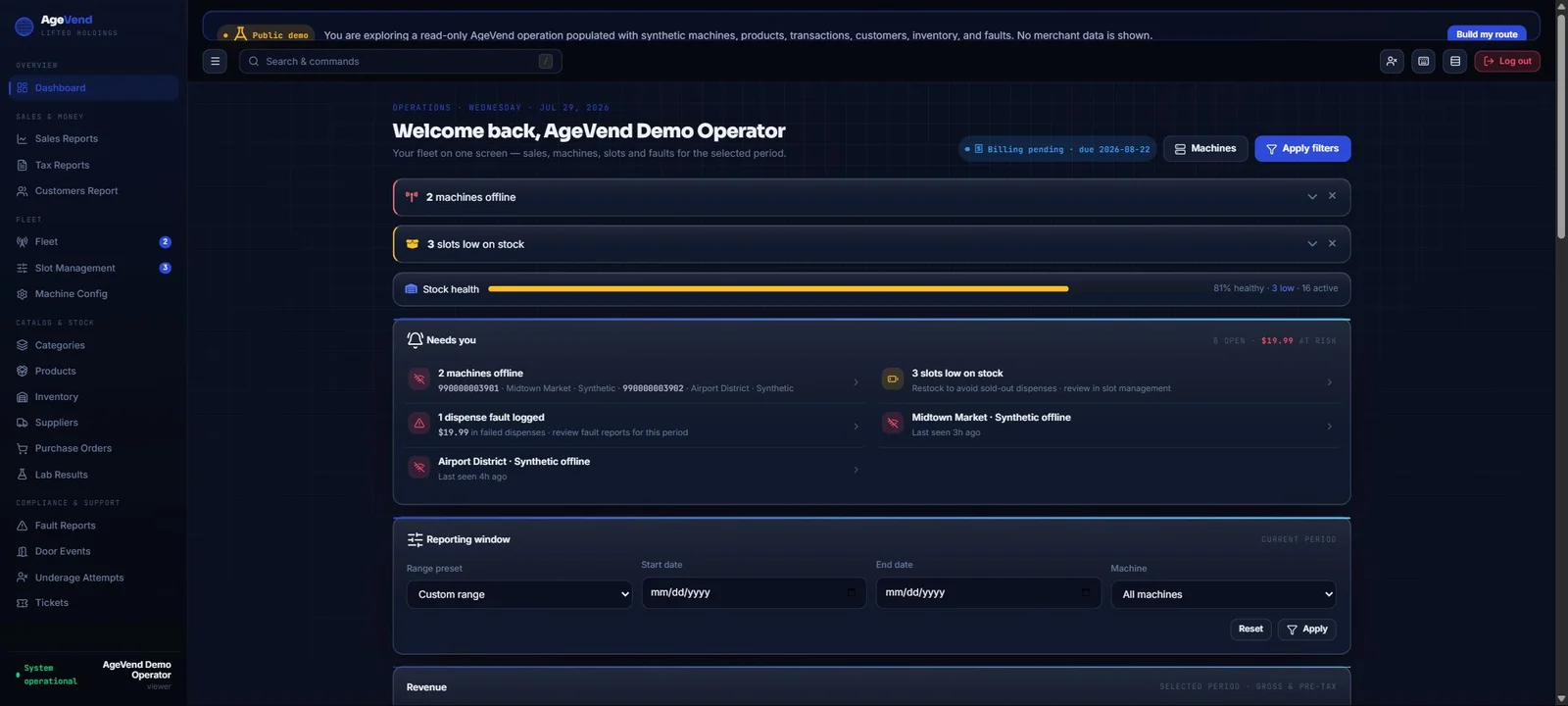
Buyers can inspect tax and order navigation in the public AgeVend operator demo. Before deployment, confirm the exact locations, products, reports, exports, roles, and change procedures required by the operating business.
Questions buyers ask
Does AgeVend include tax settings?
The operator experience includes tax configuration and reporting surfaces connected to products, locations, and orders.
Does AgeVend determine the correct tax rate?
No. Operators must determine and maintain the correct treatment with qualified tax guidance.
Should route technicians change tax settings?
Permissions should follow the operator’s control policy; routine route work usually does not require broad tax-administration access.
Can tax reports replace accounting reconciliation?
No. Operators should reconcile orders, payment settlement, refunds, adjustments, and accounting records.
Ready to evaluate the AV-1?
Start with the published $9,500 base price, a real connected-machine screen, the read-only operator demo, and a written route quote covering the complete deployment.