
Updated July 29, 2026. This commercial planning guide is not legal, tax, payment, or financing advice. Requirements vary by product, location, program, and jurisdiction.
Published transaction economics: ID + face verification is $1.00 per attempted verification. Fingerprint verification is $0.50 per successful match, with no fee on failed fingerprint scans. Card processing is provided by Lifted Payments at 3.99%; a separate payments application and approval are required before go-live.
See the complete operation.
Inspect every demo page, then request delivery scope and financing options for your route.
Connect the catalog to the physical slot
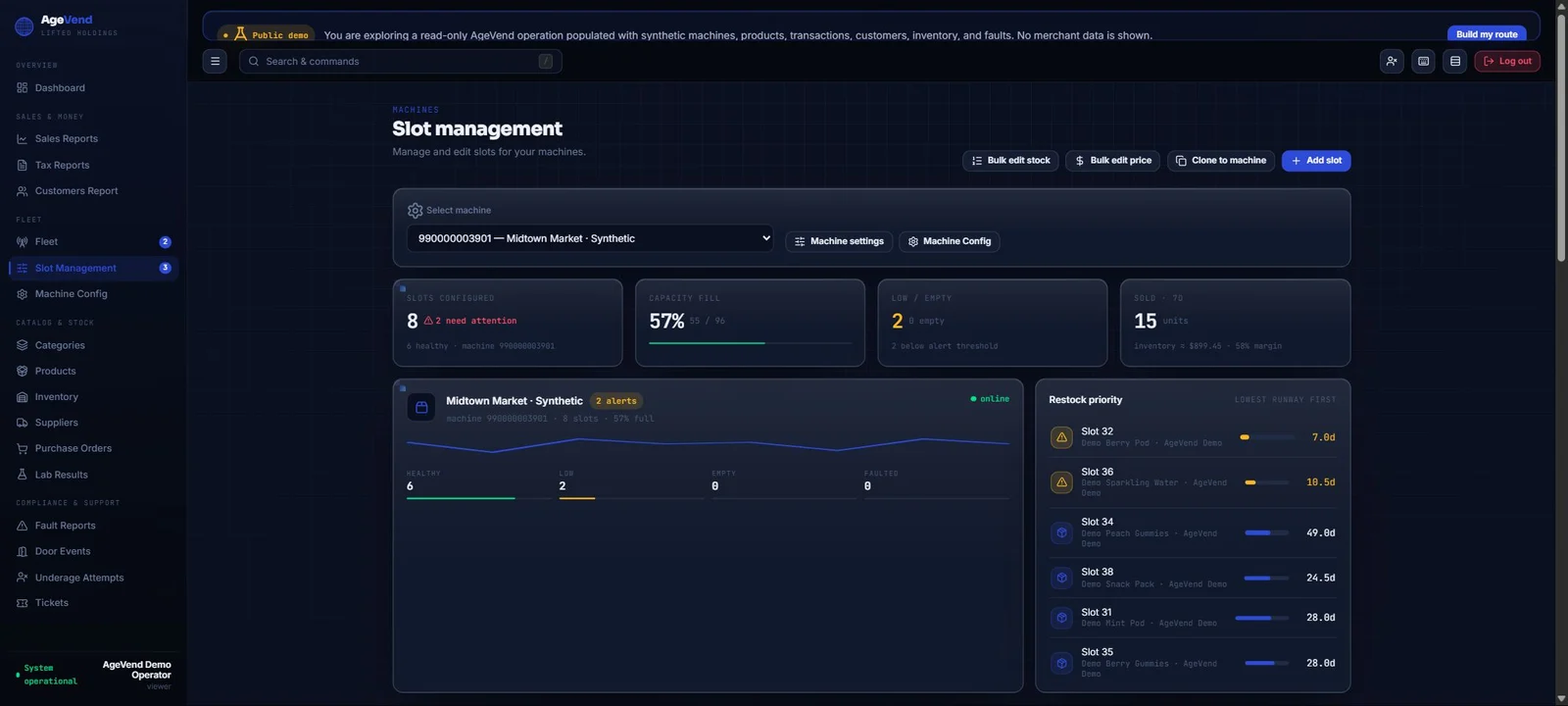
Inventory accuracy begins with a controlled product catalog and planogram. Each configured slot should point to the intended product, price, package, and capacity. The touchscreen listing must agree with the item a customer receives. When a product moves, the machine assignment and customer catalog should change together.
AgeVend’s operator experience includes product, inventory, order, and machine surfaces. Connected machines currently report 60 configured slot positions, while actual usable capacity depends on product dimensions and row configuration.
Use low stock as a route decision
A low-stock percentage alone is not a route plan. Reorder and visit thresholds should consider sales velocity, route frequency, travel time, event schedule, package capacity, reserve stock, and the cost of a stockout. A fast item at a distant venue may need a higher threshold than a slow item near the warehouse.
Prioritize the next action: bring a specific quantity, monitor until the next scheduled stop, investigate a count mismatch, or change the product mix. Keep the operator focused on exceptions instead of asking them to scan every machine manually.
Reconcile sales, deliveries, and physical counts
System inventory changes when a successful delivery is recorded, but real operations also include failed deliveries, test vends, damage, expiration, theft, restocking errors, and manual removals. Define reason codes and permissions for adjustments so unexplained changes do not silently erase the evidence needed to investigate shrink.
At each service visit, compare the expected quantity to the physical count and record material variances. Repeated differences in one slot or machine can point to planogram fit, delivery, receiving, or procedure problems.
Manage reserve inventory and receiving
A route can show perfect machine counts and still fail if reserve inventory is unknown. Record product received, storage location, quantity, cost, lot or expiration when relevant, quantity loaded, and remaining stock. Separate inventory that is damaged, recalled, expired, or held for review.
Use a consistent receiving process with the same product identifiers used in the machine catalog. Avoid duplicate product records caused by small naming or package variations.
Improve the product mix with evidence
Review sell-through, stockouts, days in machine, margin, expiration, and failed delivery by product and location. A high seller that remains empty is a replenishment problem; a full slot with no movement may be a placement, price, product, or visibility problem.
Change one planogram decision at a time and document the date. That creates a usable comparison and avoids mistaking seasonal traffic or a campaign for a permanent product trend.
Inspect inventory before purchasing hardware
A software demonstration should show product creation, machine assignment, stock status, order impact, and the exception path for a mismatch. Ask how permissions, audit history, offline machines, and failed deliveries affect counts.
The public AgeVend operator demo uses synthetic products, slots, orders, and machine data so buyers can inspect the inventory navigation. Confirm exact workflows and integrations for the proposed deployment in writing.
Questions buyers ask
Does AgeVend show machine inventory?
The operator experience includes product, inventory, order, and machine surfaces, with a public read-only demo using synthetic data.
How many slots does the AV-1 have?
Connected AgeVend machines currently report 60 configured slot positions; usable capacity depends on package dimensions and configuration.
Does a sale always guarantee the physical count is correct?
No. Failed deliveries, adjustments, damage, restocking errors, and shrink require reconciliation procedures.
Can inventory data replace physical counts?
No. Operators should perform risk-based physical reconciliation and document material variances.
Ready to evaluate the AV-1?
Start with the published $9,500 base price, a real connected-machine screen, the read-only operator demo, and a written route quote covering the complete deployment.