
Updated July 29, 2026. This commercial planning guide is not legal, tax, payment, or financing advice. Requirements vary by product, location, program, and jurisdiction.
Published transaction economics: ID + face verification is $1.00 per attempted verification. Fingerprint verification is $0.50 per successful match, with no fee on failed fingerprint scans. Card processing is provided by Lifted Payments at 3.99%; a separate payments application and approval are required before go-live.
See the complete operation.
Inspect every demo page, then request delivery scope and financing options for your route.
Turn machine signals into an operating queue
Connected vending equipment can produce many signals, but an operator does not need an endless wall of telemetry. The useful view is a prioritized queue: which machine reported the condition, what category it belongs to, when it began, whether it is still active, and whether it affects customer transactions or product delivery.
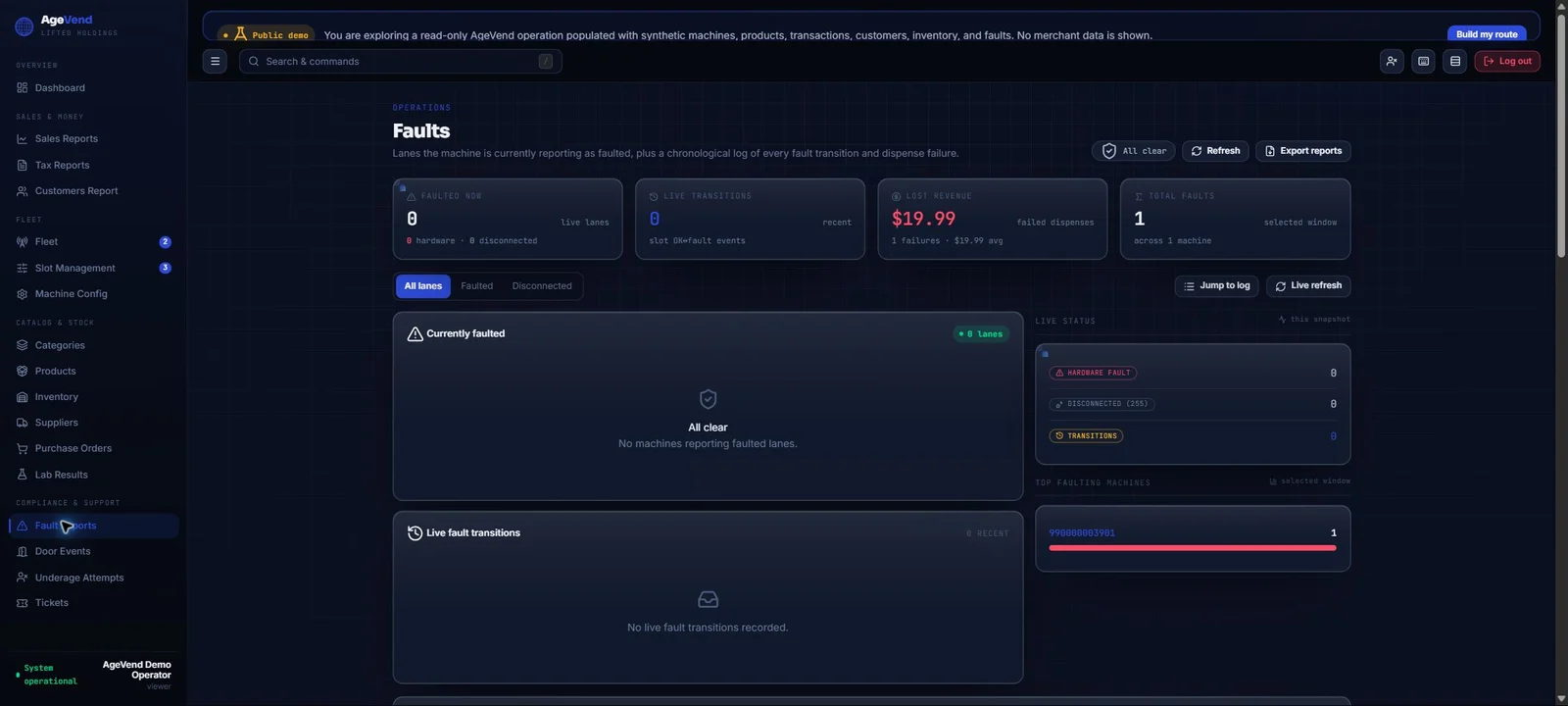
AgeVend’s operator experience includes machine and fault surfaces designed to put exceptions next to the rest of route operations. A manager can review the fleet, open the relevant record, and use the available context to decide whether the next step is remote investigation, a venue check, customer support, or a service visit.
Distinguish severity from urgency
Not every alert should stop the route, and not every severe-looking message has the same commercial impact. Classify faults by the affected function—connectivity, payment, customer screen, delivery mechanism, cabinet, sensor, or software—and by whether sales can continue safely. Add timestamps and current status so an old resolved event does not compete with a new active one.
Route procedures should define who owns each class, expected response time, and the evidence required before closing it. That keeps a warning from becoming a permanent badge and prevents a technician from arriving without the machine identifier, location, recent events, and replacement parts likely to be relevant.
Connect faults to customers and orders
The most important exception is often the one a customer experienced. When payment, verification, or delivery does not complete as expected, support needs enough order and machine context to investigate. The customer-facing kiosk should provide a clear support path, while operator tools should avoid exposing unnecessary personal or payment data.
A documented workflow can link the time of the report to machine activity, inventory movement, and the customer’s description. Operators should define who may issue refunds or adjustments, how those actions are recorded, and what evidence is preserved for processor, venue, or service review.
Use history to prevent repeat failures
A fault history becomes valuable when it reveals recurrence: the same slot, machine, location, network condition, or service pattern appears repeatedly. Review counts and intervals alongside sales and service activity instead of treating every incident as isolated. Repeated low-level exceptions can create more lost sales and route labor than one obvious outage.
Record the response, resolution, and any part or configuration change. That history helps the next technician begin with evidence and helps management decide whether to adjust a planogram, venue network, maintenance interval, or machine configuration.
Build a remote-first response procedure
Remote visibility does not mean every physical issue can be repaired from a browser. It means the team can make a better decision before rolling a truck. Start by confirming machine identity, location, online state, recent orders, active faults, and whether the venue can safely perform a simple visual check.
Limit remote actions to authorized operators, document changes, and define escalation boundaries. A remote restart or configuration change should not substitute for a safe on-site inspection when hardware, electrical, product, or customer-safety conditions require it.
Inspect the fault experience before buying
Ask a vending provider to show an active queue, a resolved report, the machine record, and the response workflow—not only a dashboard total. Confirm how quickly status updates, who can see or change records, and how the system behaves during connectivity loss.
The public AgeVend operator demo uses synthetic machines and faults so buyers can inspect the navigation without accessing merchant data. Pair that review with a written description of the selected machine configuration, support scope, connectivity, and service responsibilities.
Questions buyers ask
What appears in an AgeVend fault report?
The operator experience is designed to surface the affected machine, fault category, status, timing, and related operating context available to the route team.
Can every fault be repaired remotely?
No. Remote visibility can improve triage and preparation, but physical, electrical, product, and safety issues may require an authorized on-site response.
Does the public demo use live merchant faults?
No. The public operator demo uses synthetic fleet and fault data and is read-only.
Should a fault automatically trigger a refund?
Not by itself. Operators should review the order and machine context and follow their documented support and payment procedures.
Ready to evaluate the AV-1?
Start with the published $9,500 base price, a real connected-machine screen, the read-only operator demo, and a written route quote covering the complete deployment.