
Updated July 29, 2026. This commercial planning guide is not legal, tax, payment, or financing advice. Requirements vary by product, location, program, and jurisdiction.
Published transaction economics: ID + face verification is $1.00 per attempted verification. Fingerprint verification is $0.50 per successful match, with no fee on failed fingerprint scans. Card processing is provided by Lifted Payments at 3.99%; a separate payments application and approval are required before go-live.
See the complete operation.
Inspect every demo page, then request delivery scope and financing options for your route.
Start with a fleet you can actually see
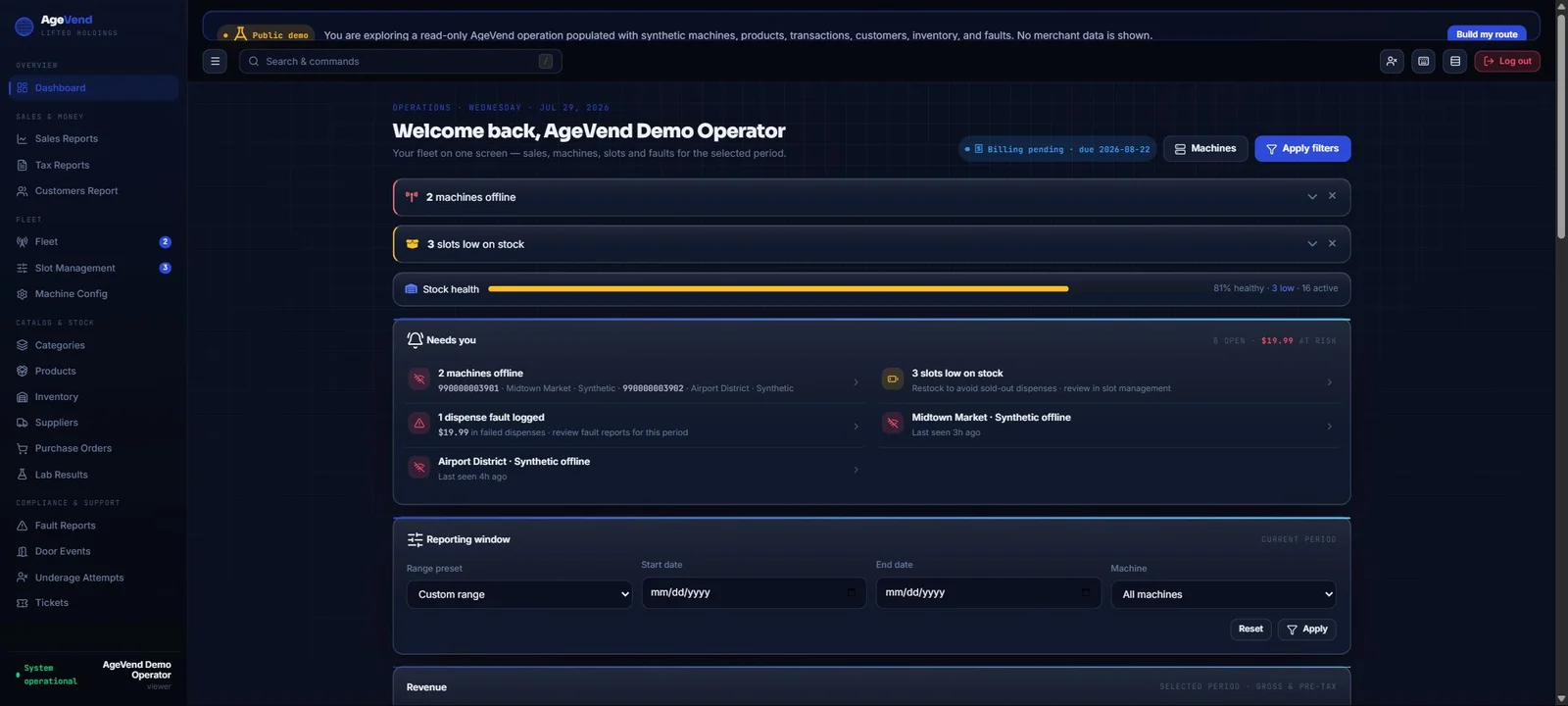
A remote console should identify every machine, tenant or operating account, location, current status, and recent activity. The first screen must help an operator find the exception: offline equipment, low stock, a delivery issue, a customer ticket, or a configuration that needs review.
AgeVend brings machine status, faults, products, inventory, orders, customers, tax, campaigns, tickets, and team access into the operator experience. Buyers can inspect those destinations in a read-only public demo populated with synthetic data.
Manage products, prices, and planograms
Remote product control connects the customer catalog to the physical machine. Operators need a disciplined workflow for product details, images, prices, availability, machine assignment, and slot configuration. A change should be reviewed against package fit, inventory, tax treatment, venue agreement, and applicable product requirements.
Define who may propose, approve, and publish a price or catalog change. Preserve the date and scope so support and accounting can understand which configuration governed a transaction.
Run the route from stock and exceptions
Inventory status helps the route decide what to carry and where to go. Fault and machine status help decide whether a location needs remote investigation, a venue check, or service. Orders and support provide the customer context behind an exception.
The goal is fewer blind trips and faster prepared responses, not a claim that physical operations disappear. Restocking, cleaning, inspection, repair, receiving, security, and venue coordination remain real work.
Control the customer-facing experience
The touchscreen storefront is managed content: products, images, prices, availability, campaigns, loyalty access, support, and product documentation need governance. AgeVend’s connected kiosk includes customer-facing lab reports access for operator-maintained tested-product information.
Campaign and catalog changes should follow role-based permissions and review. Operators remain responsible for claims, required disclosures, product eligibility, pricing, and the accuracy of published documentation.
Separate roles and preserve accountability
A growing route may include owners, managers, route staff, technicians, accounting, venue partners, and customer support. Give each person the least access needed for the job. Viewing machine status should not automatically grant permission to change tax settings or publish a campaign.
Record material changes and decisions. Remote access is powerful precisely because it can affect many machines; user identity, scope, time, and prior state should be available when the operator investigates a problem.
Evaluate the whole operating system
Do not evaluate remote management from a screenshot of cumulative revenue. Walk through a product change, low-stock condition, fault, failed delivery, customer question, tax review, user permission, and machine status change. Ask what continues to work if connectivity is interrupted.
Open the full AgeVend operator demo to inspect the current navigation with synthetic data, then request a written demonstration of the exact configuration and permissions proposed for your deployment.
Questions buyers ask
What can an AgeVend operator manage remotely?
The operator experience includes fleet and machine status, products, inventory, orders, customers, tax, faults, campaigns, tickets, and team access.
Does remote management eliminate route visits?
No. Physical stocking, inspection, cleaning, repair, receiving, and venue coordination still require operating procedures.
Can buyers inspect the software?
Yes. AgeVend publishes a read-only operator demo with synthetic machines, products, transactions, and faults.
Can every user change every machine?
Access should be role-based and scoped to the responsibilities defined during implementation.
Ready to evaluate the AV-1?
Start with the published $9,500 base price, a real connected-machine screen, the read-only operator demo, and a written route quote covering the complete deployment.